Partizan Belgrade
Partizan Belgrade
| Foundation | 1945 | |
| Arena | Štark Arena | |
| Championships | Adriatic League / EuroLeague | |
| Coach | Joan Peñarroya | |
| Famous players who have played for the club | Dante Exum / Bogdan Bogdanović / Nikola Peković |
Player to watch : Lamar Stevens
In the summer of 2025, it was announced that a physical behemoth straight from the NBA was set to arrive in my capital city. One season on, the baskets of the French league still bear the marks of Lamar Stevens’ monstrous dunks. In his first season outside North America, this physically imposing forward has gone from strength to strength. Hampered by injury until November, the Philadelphia native had to cope with a shortened settling-in period at Paris Basketball, resulting in a campaign marked by ups and downs.
His qualities on both ends of the court have spoken for themselves since he signed for Partizan Belgrade. Capable of transforming himself into a defensive wall before exploding on the fast break, Lamar Stevens is the archetypal athlete straight out of the North American mould. This year in Serbia looks set to be particularly interesting for him. It will be an opportunity to see whether he is capable of becoming a key player for an ambitious EuroLeague side.
Playing style

Željko Obradović’s resignation in the middle of the 2025-2026 season sent shockwaves through Belgrade. Replaced at short notice by Joan Peñarroya, the team’s early flashes of brilliance bear the hallmarks of Obradović’s style. With far more freedom on the ball, the Serbian guards prioritise finding space above all else. Partizan does not hesitate to create gaps and mismatches by making extensive use of the pick-and-roll. There is also a strong connection between the ball-handler and the big men. These screens also create opportunities for drives and cuts into the paint.
Without the ball, Belgrade deploys a particularly compact 2-3 zone. Joan Peñarroya seems to prioritise defending the paint over the perimeter. To compensate for this imbalance, the players remain very aggressive on the ball-handler. Discipline, team cohesion and tactical rigour are also fundamentals that the players follow to the letter.
Club history
The Partizan Belgrade basketball club was founded on 4 October 1945. At the time, the section was part of the Sports Society of the Central House of the Yugoslav Army (CDNJA Partizan). In other words, it was formed from the Yugoslav Army’s basketball team. This rather unique status came to an end in 1953. During its first 30 years, the capital city side finished second in the league five times, including twice on the same points as the winners. There was no shortage of talented players or Serbian internationals. Yet no Partizan side managed to lift a single trophy.
The turning point came in the early 1970s. For the first time, former Partizan players joined the club’s management and appointed the former national team manager, Ranko Žeravica, as head coach. Throughout that decade, he and his former assistants Ćorković and Ivković maintained the same approach, blending Soviet-style discipline with American modernity. This innovative style of play bore fruit in 1976 when the Crno-beli won their first league title. This was followed by two more titles by 1981, topped off by a Serbian Cup. This philosophy made its mark across Europe, with the Belgrade club winning back-to-back Korac Cups (C3) in the 1978 and 1979 seasons.
A strong affinity for Europe was carried on by Željko Obradović’s teammates, including Milenko Savović and Aleksandar Đorđević, from the late 1980s into the early 1990s. Following a few quieter years, Partizan returned to the top of Yugoslavian football in 1987 by winning the league and cup double. And on the Old Continent, the Belgrade side came close to the holy grail. They finished third in the 1987 European Champions Cup (C1) and then won the Korać Cup (C3) for the third time in 1989. This second successful cycle came to an end with the departures of Divac, Paspalj, Grbović, Savović and many other key players. The 1991–1992 season became a testing ground where the new head coach, Željko Obradović, launched a new generation. A situation that was already far from straightforward, made even worse by the war. Forced to play in Spain, the Crno-beli reached the Final Four of the European Champions League (C1) to everyone’s surprise. Just imagine, this team had an average age of 21.7! Serbian passion saw them beat the Italians of Philips Milano before Aleksandar Đorđević sank an iconic three-pointer in the dying seconds against Montigalà Joventut in the final (71-70). They’d done it: they were European champions and, in the process, had achieved a historic treble.
This achievement came at just the right time, as the club was barred from continental cup competitions until 1995 due to UN sanctions. During this lean period, KK Partizan won a single league title. And to round off the millennium in style, the Serbs secured back-to-back domestic cup titles whilst reaching their third Euroleague Final Four in 1998. The return of Duško Vujošević as head coach marked the beginning of a ruthless dominance on the domestic scene. The KLS title won in 2002 was the first in a long run of 13 consecutive triumphs. With the domestic title secured, Belgrade turned its attention to the regional stage. From 2007 to 2013, the club won the Adriatic League six times. And after two consecutive quarter-finals, the Serbs reached the EuroLeague Final Four (C1), where they suffered two disappointing performances: one against Olympiacos (80-83) and another in the third-place play-off against CSKA Moscow (88-90). When Vujošević left the capital in 2010, three seasons followed in which the team was rejuvenated before the Black and Whites suffered their second trophy-less season in their modern history in 2015.
A period of financial hardship then swept through Belgrade. For three years, Partizan teetered on the brink of crisis, sacked Petar Božić following the worst half-season in their recent history, changed head coach every six months and racked up €7 million in debt. In 2018, the club saw the light at the end of the tunnel by winning its first title in four years. Better still, they achieved the three-peat! At the end of this fine run, Željko Obradović – a nine-time EuroLeague (C1) winner – returned with big-name players such as Kevin Punter, Mathias Lessort and Zach LeDay in his squad. 3,121 days later, the Crno-beli won one EuroLeague (C1) match before finally bowing out in the quarter-finals in Game 5 against the eventual champions from Madrid. And more recently, in 2025, Partizan became the most successful club in the ABA League whilst also clinching the national title.
awards and honors
| EuroLeague (C1) | 1992 | |
| Korać Cup (C3) | 1978 / 1979 / 1989 | |
| Serbian Champion | 1976 / 1979 / 1981 / 1987 / 1992 / 1995 / 1996 / 1997 / 2002 / 2003 / 2004/ 2005 / 2006 / 2007 / 2008 / 2009 / 2010 / 2011 / 2012 / 2013 / 2014 / 2025 | |
| Serbian Cup | 1979 / 1989 / 1992 / 1994 / 1995 / 1999 / 2000 / 2002 / 2008 / 2009 / 2010 / 2011 / 2012 / 2018 / 2019 / 2020 | |
| Adriatic League | 2007 / 2008 / 2009 / 2010 / 2011 / 2013 / 2023 / 2025 |
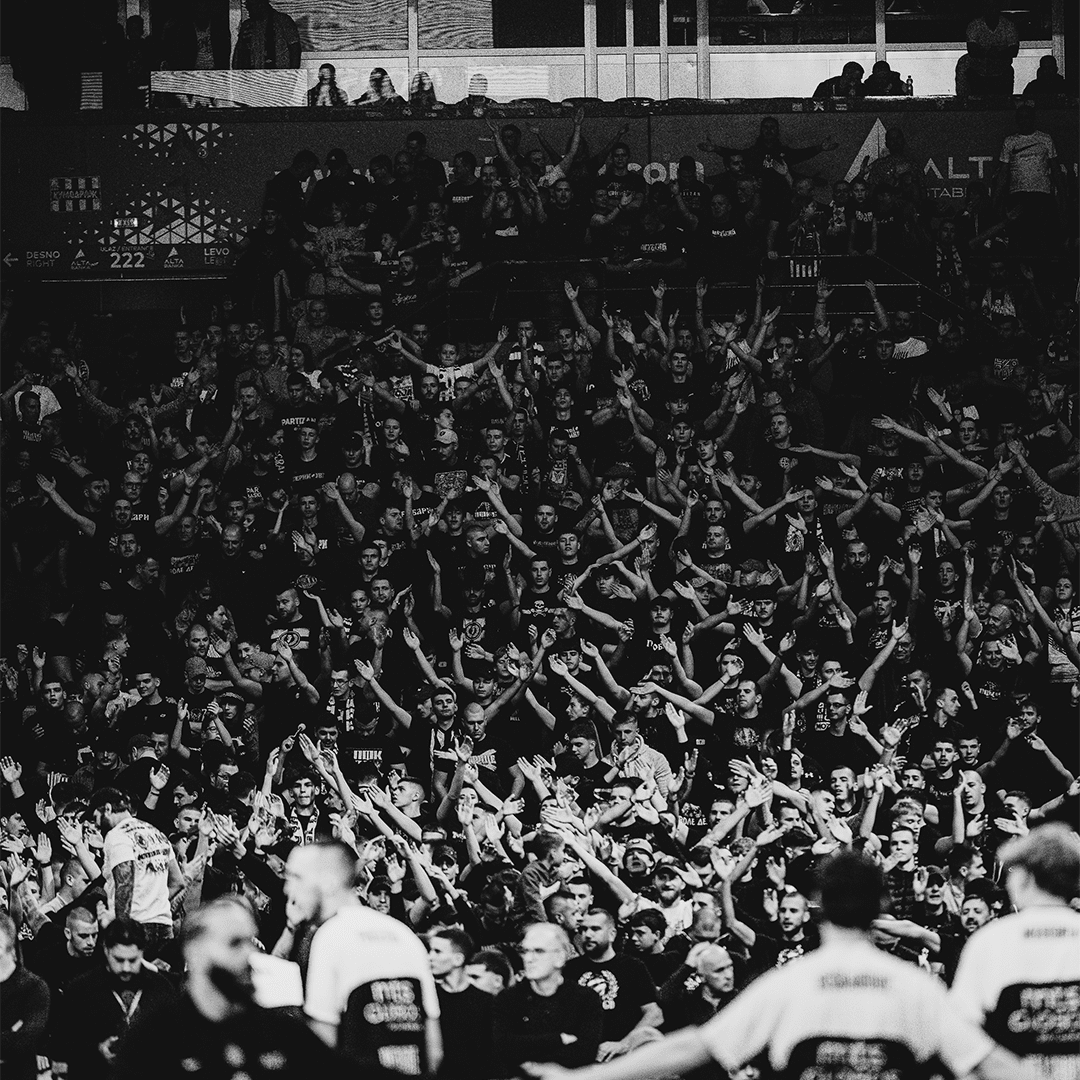
Zoom : Grobari
If the Štark Arena is considered the most hostile venue in the EuroLeague (C1), it is largely thanks to—or because of (depending on your point of view)—the ‘Grobari’. Founded in 1970, KK Partizan Belgrade’s main supporters’ group is the lifeblood of this one-of-a-kind cauldron. Non-stop chanting, giant tifos, smoke bombs, perfect coordination in the stands, constant pressure on the referees and the opposition… Playing a match there is like playing in a deafening atmosphere for 40 minutes.
Their name alone says a lot about them. In Serbian, Grobari literally means ‘gravediggers’. This nickname was given to them in the late 1970s by Red Star Belgrade supporters, because Partizan’s kits resembled those worn by gravediggers at the time.
The Number : 22 567
This is the attendance figure recorded for the Partizan Belgrade v Panathinaikos match on 5 March 2009 – the highest official attendance for a EuroLeague match to date.
Other Teams