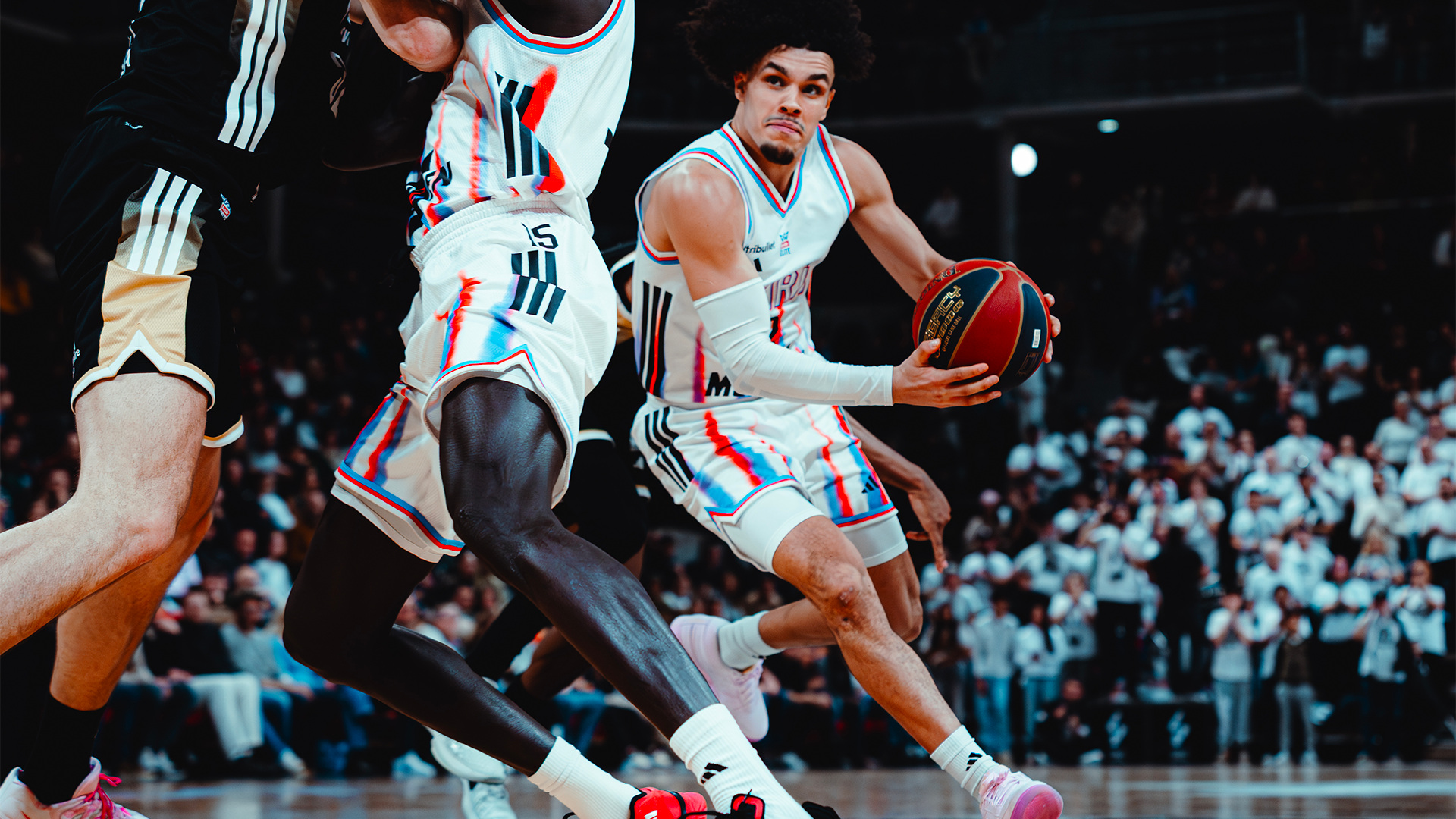
Basketix Glossary : Double Step
At Paris Basketball training, it’s the first move we practise. It’s the basis of attacking on the move. Yet, in the stands or in front of the TV, it’s often the most misunderstood move. ‘That’s travelling!’ you shout, you naughty basketball fan. Not so fast. The double step is an exact science.
Definition of the double step : 1, 2, Boom
In Basketix, the double step (or ‘lay-up steps’ in English) is the footwork that precedes a running shot.
It is the only fundamental exception to the dribbling rule. The FIBA and NBA rules are clear: once dribbling has stopped, a player is allowed to take two steps before releasing the ball (shot or pass).
Classic mechanics :
– Dribble: The player pushes the ball.
– Control: He catches the ball with both hands.
- – Support 1: The right foot touches the ground (for a right-handed player).
- – Support 2: The left foot touches the ground – and is used for momentum.
- – Shot: The player jumps towards the hoop and releases the ball.
What if a third support touches the ground while the player still has the ball? Whistle. Travelling. Ball to the opponent.
But beware, modern basketball has complicated matters with the ‘zero step’ (gather step). Today, the foot that is on the ground at the precise moment the player picks up the ball does not count as the first step. It is the ‘zero’ step. The player is therefore allowed two additional steps. The visual result? It sometimes looks like the player is taking three steps. It’s legal, it’s technical, and it drives defenders crazy.
The role of the double step in modern basketball
The double step is no longer a simple straight line towards the basket. It has become a powerful feinting weapon.
In today’s basketball, dominated by ‘Pace and Space’, defences retreat quickly. Going straight ahead with a classic 1-2 means getting blocked by a 2.15 m centre waiting for you in the paint. Attackers have had to adapt the double step. It is no longer just used to move forward, but also to throw the defender off balance.
The advent of the Euro Step: This is the queen of variations. Instead of taking two steps forward, the player takes one step to the right, then a big step to the left (or vice versa). It’s a slalom at full speed. The defender anticipates contact on the first step, but the attacker has already moved to the other side on the second.
Synergy Sports statistics show that players who master double-step variations (Euro Step, Hop Step) get more free throws. Why? Because the defender, caught off balance, is often forced to foul. This is crucial for teams like Paris Basketball, which thrive on transition. Knowing how to lengthen your stride to avoid contact is as vital as knowing how to shoot a 3-pointer.
The masters of footwork : Giannis and the ‘Beard’
While everyone learns the double step as youngsters, some have turned it into a lethal art at the professional level.
The mutant : Giannis Antetokounmpo. The ‘Greek Freak’ has broken the double-step code. Thanks to his height (2.11 m) and endless legs, he covers an unreal distance. He is capable of picking up the ball behind the 3-point line and finishing at the hoop without dribbling, just with his ‘zero step’ and his two authorised steps. The stats back this up: Giannis regularly leads the NBA in points scored in the paint (around 18 points per game), almost entirely thanks to this stride that renders the defence powerless.
The bebar : James Harden. He is the most controversial player. He forced the NBA to rewrite its rules on travelling. Harden is the master of deceleration. He arrives quickly, takes his ‘zero step’, freezes the defender, and takes his two steps very slowly to finish. The fans cry foul, the referees validate it. It’s exploitation of a regulatory loophole at the highest level.
Manu Ginobili : The Argentine player for the Spurs brought the Euro Step to the NBA in the early 2000s. Before him, the double step was vertical. With him, it became lateral. Wade, Harden and Giannis are all his heirs.
A legendary move: Wade becomes ‘The Flash’
2006 NBA Finals. Game 3. Miami Heat vs Dallas Mavericks. The Heat are down 2-0 in the series. In the fourth quarter, they are on the brink of defeat, trailing by 13 points. The season seems to be over.
That’s when Dwyane Wade decides to stop just running and start dancing. It wasn’t just one basket, but a sequence at the end of the game that traumatised America. Wade repeatedly attacked the basket. On a key possession, he drove to the paint. Erick Dampier (the Mavs’ centre) was waiting to block him. Wade unleashed his double step :
- First strong step to the right : Dampier takes the bait and shifts his weight.
- Second sudden step to the left, passing the ball low to the ground under the defender’s arms.
He finished smoothly as the giant swung and missed. Wade ended the game with 42 points and 13 rebounds. He used the double step (and especially the Eurostep) to draw a flurry of fouls and turn around a desperate situation.
 Article by alexis gallot
Read also
Milwaukee Bucks 1970–1971 : Year Zero

Top 10 favorites for March Madness 2026
Bob Pettit : The Bomber from Baton Rouge
CELTICS 1986 : The height of dominance
Walt Frazier : When the Garden Was Eden
Top 10 NBA Draft 2026
Latest items
MIAMI HEAT 2012-13 : The King’s era in back-to-back mode
The 95-96 Bulls : The Ultimate Team

Top 10 all-time best Euroleague point guards